
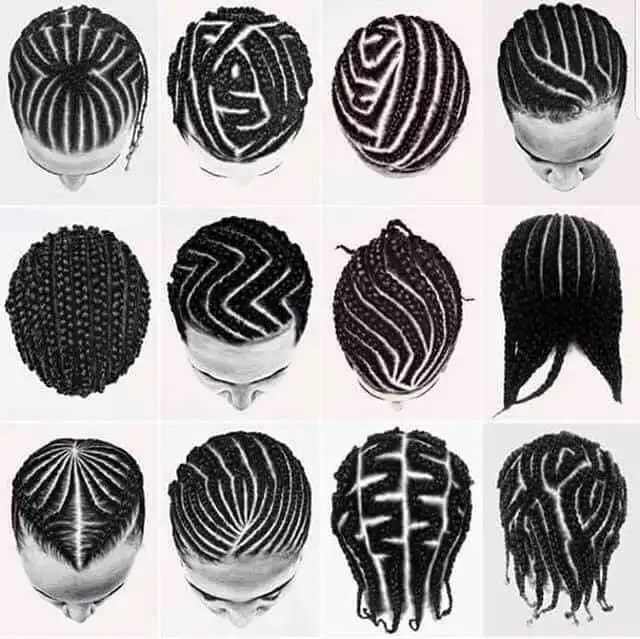
The more you read, the more you learn. Recently, I saw a post on some Facebook history page about slaves using cornrows in their hair to aid their escapes and communicate with one another. The topic was fascinating, but bordered on the unbelievable, so I set about researching it.
Well, much to my satisfaction, these stories are widely considered to be true!
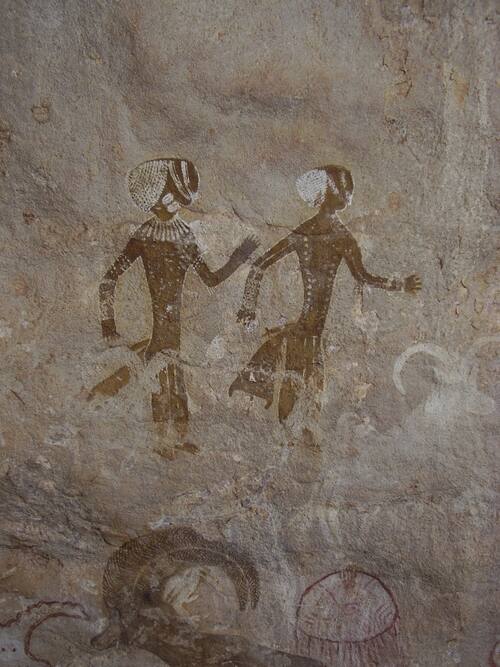
Archeologists have found images depicting cornrows in hair dating as far back as 5,000 years in Tassili n’Ajjer cave paintings in North Africa! That’s a long time in terms of human history. In fact, depictions of braids themselves date back as far as 30,000 BC on sculptures excavated in Austria.
But cornrows are much different than mere braids. In tribal Africa, certain braided patterns were used to indicate both tribe and status within the tribe. They could communicate information about an individual such as religion, age, marital status, wealth, power, and social position. Different patterns were worn for different occasions too, such as weddings and other ceremonies.
The cultural significance of hairstyles was well known to slavers in the 16th century and beyond. That’s why, when these tribes were raided and their members taken into the transatlantic slave trade, their heads were typically shaved. It was one of many ways to separate them from their heritage and identity. It can only be imagined how traumatizing, on top of everything else, this was.
But, as I’ve learned, these Africans were extremely resilient and resourceful.
One thing to bear in mind is that there were many thousands of tribes scattered throughout Africa, speaking as many different languages. Africans communicated between tribes in a wide variety of ways beyond the spoken word. As is represented in the pages of my book, stories were passed on using many forms of art and music, and long-distance messages were transmitted by drum. This is why the enslaved weren’t allowed to have instruments and drums on plantations.
So, why is it so hard to imagine that they could also embed messages into their hairstyles?
Like most of Black history from the transatlantic slave trade, stories were passed on verbally from generation to generation. Since the enslaved weren’t permitted read and write, not much was written down. But that doesn’t make things any less true.
As I was doing my research, I came across an article in the Washington Post from 2011. It was an interview with a woman named Asprilla Garcia. She was an Afro- Colombian woman giving traditional hair braiding demonstrations at the Smithsonian Folklife Festival in DC. She described that her method had been passed down through the generations from the time her ancestors were enslaved in that country.
She explains that different hair styles told different stories. For instance, one style, called departes, indicated that a woman wanted to escape (depart). Other hairstyles had curvy braids representing certain roads for escape. In many instances, the escaping slaves would incorporate seeds and gold as well to help them survive after escaping.
In a different article, I learned that certain “worm-like” braids denoted a river, and a type of knot signified a mountain. A thicker style of braid called tropas, a word literally meaning troops, showed where soldiers might be.
Unfortunately, for a variety of difficult to understand reasons, Afro hair has become a certain brand of racism, known as “textureism,” referring to the coarse texture typical of Afro hair. For a long time, descriptions of African hair by the white community have been derogatory in nature, describing it as wooly, bushy, dirty and unkempt.
During slavery, a common punishment for small infractions was head shaving. This was because slave masters knew the importance of hair in African cultures. In 1786, the Tignon Law was passed in Louisiana requiring Black women to wrap their hair in a knotted headdress when in public. This was mainly to safeguard elite white women from being ‘outdone’ and make sure Black women didn’t appear too glamorous. Around the time of abolition, society came to refer to kinky or tightly curled African hair as “bad hair”.
This sort of discrimination continued through the Jim Crow period, and has followed us into present day. Many people with a limited world view saw African hair and ethnic hairstyles as unprofessional and even offensive in modern American society. Some employers and other institutions such as schools developed policies prohibiting certain appearances reflecting ethnic origins or even natural hair.
Several incidents involving hair discrimination in the mid 70’s up through 2019 resulted in lawsuits. Eventually, an act known as the CROWN Act, the acronym standing for “Create a Respectful and Open Workplace for Natural Hair,” was passed in California. Since then, it has been passed in 26 more states, with passage pending in most other states. In 2022 the act passed in the US congress, but was blocked in the senate. It remains unpassed at the federal level.
Who would have thought that today, when people are dying their hair every color of the rainbow, we’d need legislation to protect a person’s right to their natural hair? And since it’s needed, who would think it still hasn’t been passed into federal law?
To receive information about upcoming projects and blog posts please click the link below.


 Peter D Brown, Author
Leave a reply to Touchin’ Jamaica Cancel reply